


Batumi’s property market in 2026 is no longer the speculative free-for-all it was in 2022–2023. The city has matured into a segmented market where two very different product types compete for buyer attention: newly built apartments from developers, and resale units from the existing housing stock. Each segment has its own price logic, risk profile, and target buyer.
Investors and private buyers who are now looking at apartments for sale in Batumi face a more nuanced decision than before. Prices have risen significantly across both segments, and the gap between new builds and resale properties has widened to a point where the choice between them has real financial consequences. Understanding what each segment actually offers in 2026 is a practical necessity before committing capital.
How the Two Markets Differ in Structure
The primary market covers purchases directly from developers, often at the construction stage. The secondary market covers completed apartments sold by private owners or investors who bought earlier. In Batumi, these two segments are not simply the same product at different price points. They operate under different supply dynamics, buyer profiles, and risk conditions.
According to Q1 2026 data from Galt & Taggart, a total of 4,049 apartments were sold in Batumi during the quarter, up 15.8% year-on-year. The secondary market showed real transaction growth of 10.1%, while the primary market recorded 21.1% growth on paper, though Colliers Georgia noted that primary transactions are often registered with delays, making the reported figure less reliable in real time.
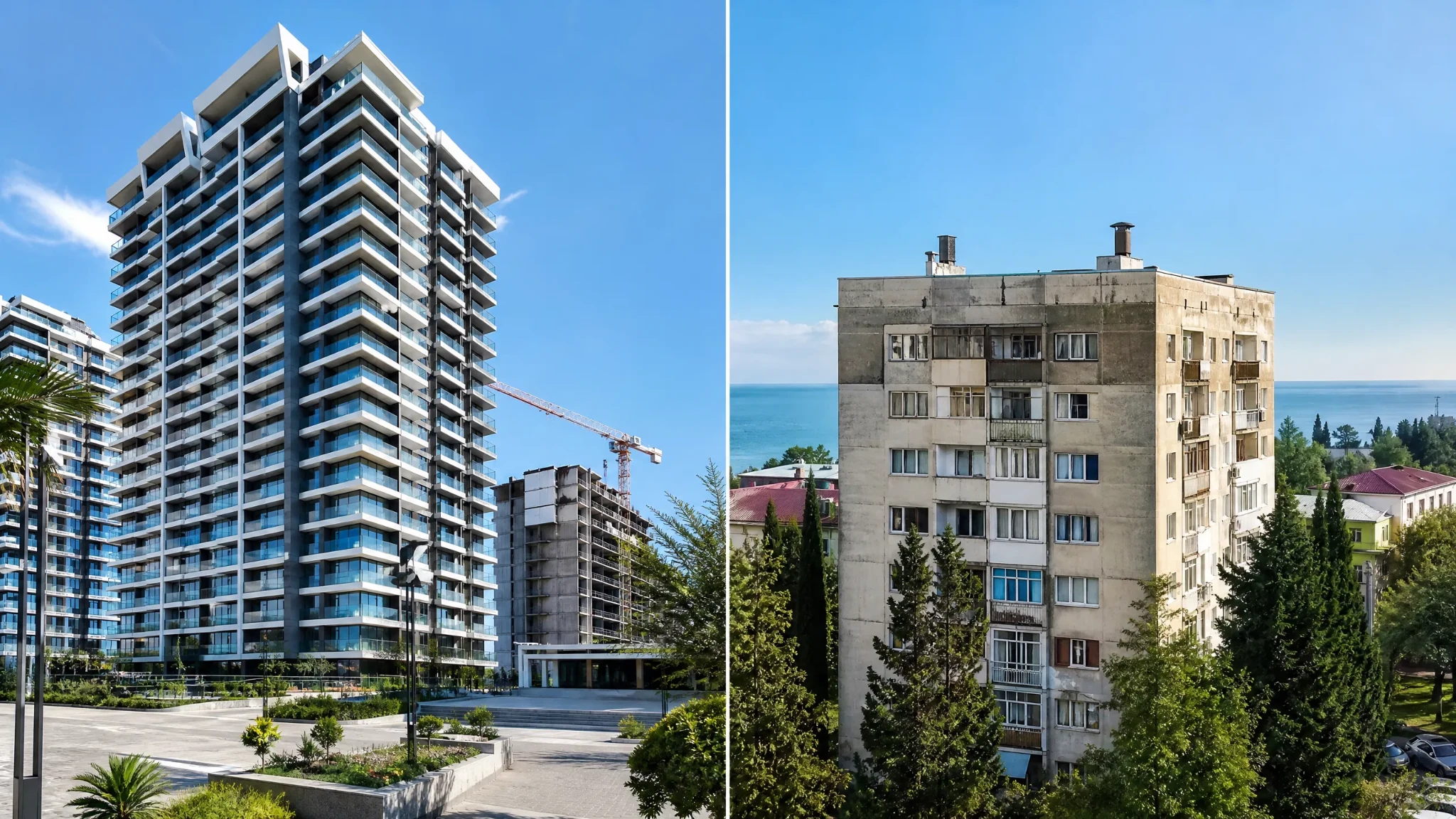
New Builds in Batumi: Prices and What You Get
New construction in Batumi covers a wide range, from bare-shell studios in peripheral districts to branded residences managed by international hotel chains. The product quality has genuinely improved over the past three years, which partly explains why new builds command a premium.
Price Ranges by Location and Finish
Prices across the new-build segment in 2026 vary substantially by area and apartment readiness:
- New Boulevard and Khimshiashvili — the most active zones for new residential development. White-frame (unfinished) apartments are priced at $1,200–$1,600 per square meter. These areas generate the highest volume of transactions and have good rental demand during the tourist season.
- Rustaveli Avenue and Old Batumi — the premium tier. Prices here reach $1,800–$3,500 per square meter, and in some boutique projects, even higher. Average prices in Old Batumi as a whole exceed $3,000 per square meter according to Galt & Taggart’s district data.
- Peripheral zones (Makhinjauri, Gonio, Kvariati) — the most affordable new construction, with prices below $1,500 per square meter. These areas attract buyers focused on seasonal rental income from tourists rather than year-round tenants.
- Branded and mixed-use complexes — projects affiliated with international hotel brands (Wyndham, Marriott, and similar chains) typically carry a 20–40% premium over standard residential new builds. In exchange, buyers get managed rental programs and professional operations, which reduces vacancy risk.
Risks Specific to New Builds
The new-build segment carries risks that are less visible in secondary market transactions. Developer financial instability is a real concern: tightened banking regulations in 2025 put pressure on some smaller developers, and a number of projects were delayed or frozen. Contracts for off-plan purchases sometimes contain clauses about maintenance fee increases or commissions on future assignment that buyers may overlook without legal assistance.
Construction quality also varies. The gap between project marketing and actual delivery remains notable in Batumi, particularly for mid-tier developers.
Secondary Market in Batumi: Prices and What You Get
The secondary market in Batumi has expanded significantly as apartments bought during the 2021–2023 boom have entered circulation. This has created more supply and more variety, including units that are fully furnished and ready for immediate rental income.
The weighted average price for secondary market apartments in Q1 2026 stood at $1,479 per square meter, up 7.8% year-on-year. That is meaningfully lower than the primary market average of $1,787 per square meter in comparable zones, which creates an entry point for buyers who want a completed product at a lower price.
Advantages of Buying on the Secondary Market
The secondary market has practical strengths that the new-build segment cannot offer by default:
- Immediate availability — there is no construction wait. A buyer can inspect the actual apartment, assess the real view, test the elevator, and evaluate the building management quality before signing anything.
- Lower entry price per square meter — at $1,479 average versus $1,787 for primary market stock, the secondary segment offers a discount of roughly 17% for a finished product. In some cases, buyers find fully furnished apartments at prices close to what a bare-shell new build would cost.
- Established rental history — many resale apartments in central Batumi already have a track record of Airbnb or long-term tenant income, which allows buyers to verify actual yields rather than relying on developer projections.
- No developer risk — the building exists. There are no completion delays, no registration delays, and no exposure to a developer’s financial situation.
Limitations of the Secondary Market
Older housing stock in Batumi is genuinely variable in quality. Soviet-era buildings and early 2000s construction often have poor insulation, outdated utilities, and no parking. Renovation costs can be high for apartments that look cheap on listing but need full refurbishment before rental. Legal due diligence is also more complex on resale units, where title history needs to be checked carefully.
Yield Comparison: Which Segment Performs Better?
This is the question most investment buyers ask first. The answer in 2026 is less clear-cut than it was two years ago.
Gross rental yield across Batumi averaged 7.1% in Q1 2026, down from 7.4% in 2025 and 8.8% in 2024. The downward trend reflects rising prices without a proportional rise in rental rates. Average daily rental rates decreased by 7.3% in Q1 2026, despite continued price growth in both segments.
The secondary market generally offers a better entry yield because the purchase price is lower. A buyer who acquires a finished, centrally located apartment at $1,400–$1,500 per square meter and achieves $10–$11 per square meter in monthly rent is working with a gross yield close to 8–9%. A buyer paying $2,000 per square meter for a primary market unit in a central location needs stronger occupancy and higher nightly rates to reach the same yield.
What Type of Buyer Suits Each Segment
The right choice depends on the buyer’s goals, timeline, and risk tolerance:
- Investors with a 5+ year horizon — new builds at the construction stage offer the best potential for capital appreciation, particularly in high-demand zones where land supply is genuinely constrained.
- Buyers seeking immediate rental income — the secondary market is more practical. A finished apartment can generate income from the first month without waiting for construction, registration delays, or renovation decisions.
- End-users planning personal residence — the secondary market allows informed decisions based on what the apartment actually looks like and how the building functions day-to-day.
- First-time buyers with limited experience in Georgian real estate — the secondary market carries fewer hidden risks, provided a legal check is completed on the title and ownership history.
Conclusion
In 2026, Batumi’s new-build segment offers higher potential upside but comes with wider price premiums, developer risk, and compressed yields. The secondary market offers a more grounded entry point, better immediate returns, and a product that can be verified before purchase.
For most buyers who are not professional developers or large-scale investors, the secondary market in 2026 is the more transparent and financially predictable option. New builds remain relevant for those with a clear long-term capital growth strategy and the capacity to manage construction-stage risk properly.